01 · Processing
What happens between the cherry and the bag.
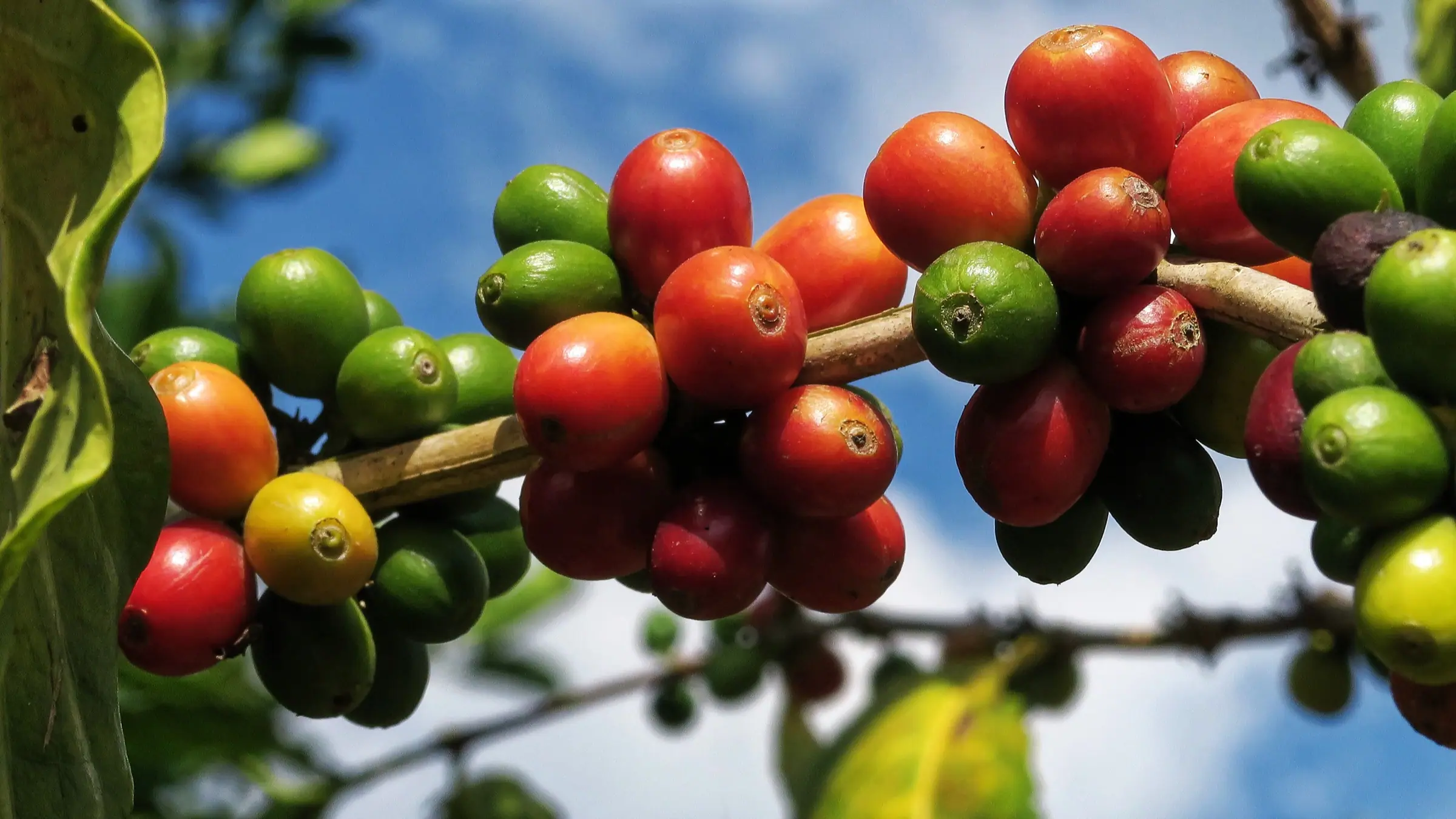
Every coffee seed grows inside a fruit. Processing is how the farm gets the fruit off and the seed dry, and it shows in the cup.
Washed
Fruit off, then fermented and rinsed
Cherries go through a pulper that strips the skin and fruit. The sticky mucilage left on the bean breaks down in fermentation tanks, usually for about half a day to two days depending on temperature. Then the parchment coffee is washed and dried.
Washed coffees often taste cleaner and brighter, with more pronounced acidity. Most of Panama’s famous Geisha auction lots compete in their own washed category.
Natural
Dried whole, fruit and all
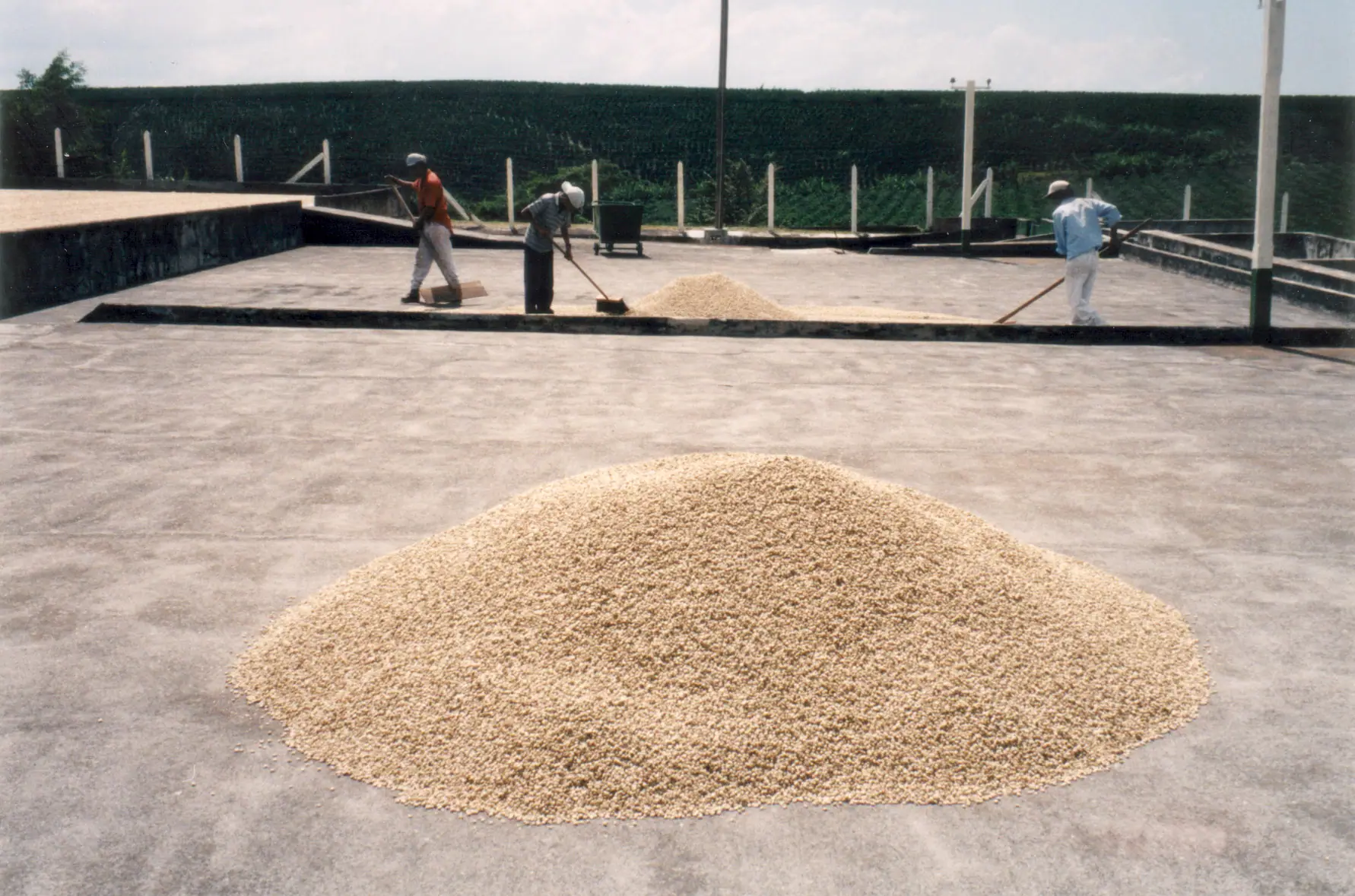
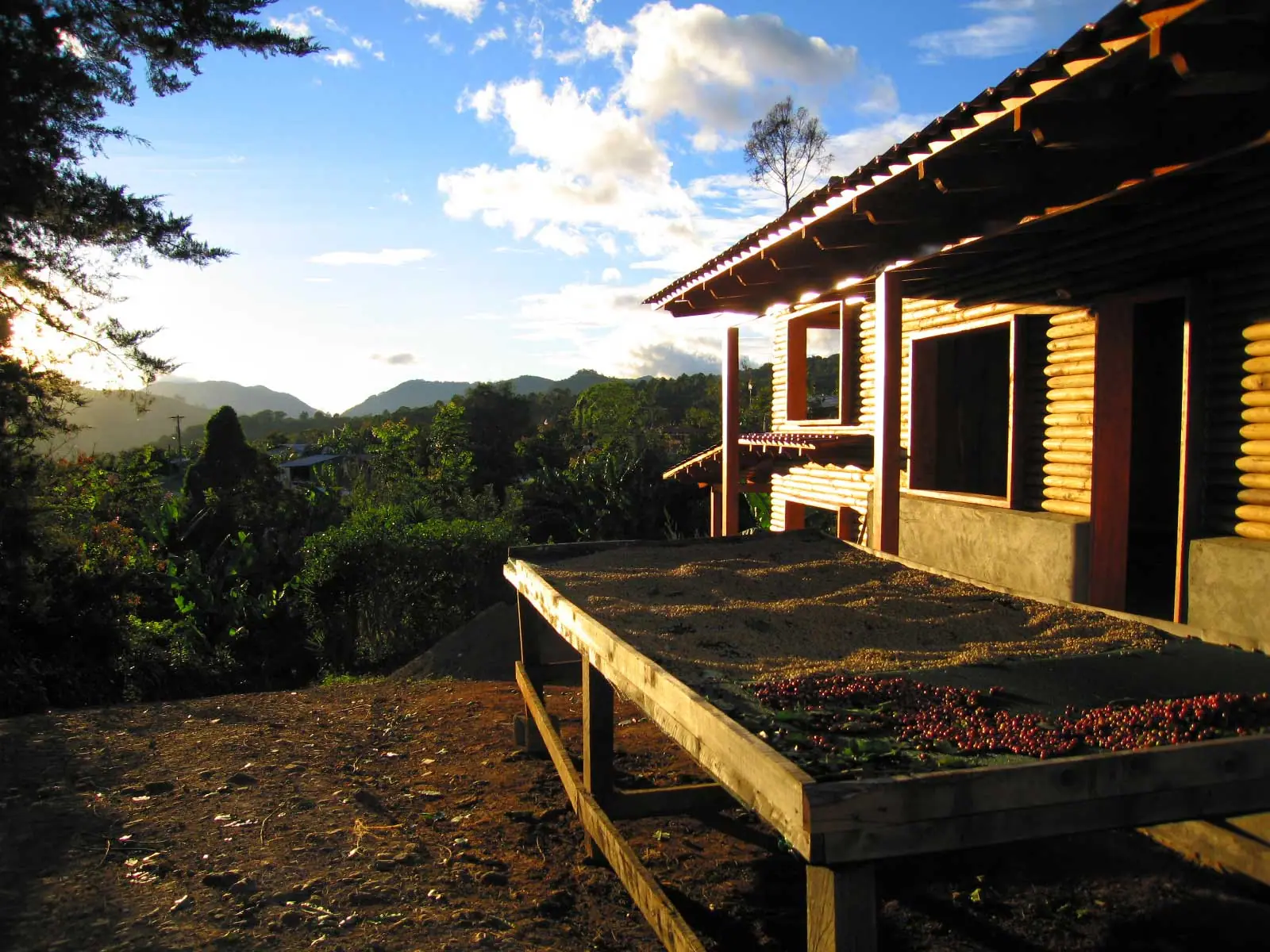
Whole cherries dry with the fruit still on, so fermentation and drying happen at the same time. Drying often takes several weeks, and some producers shade the beds to slow it down and keep fermentation steady.
Naturals often taste sweeter and fruitier, with more body. The method uses far less water than washed processing.
Honey
Pulped, dried with the mucilage on
Cherries are pulped, but the beans dry with some or all of the sticky mucilage still on the parchment. Yellow honey keeps roughly 25% of it and dries fastest. Red keeps about 50%. Black keeps about 100% and is covered to slow drying.
Beans are raked often at first, then turned daily for at least 6 to 8 days. Costa Rican farmers popularised the method.
Anaerobic
Fermented in sealed tanks
Cherries or pulped beans ferment in sealed tanks, often fitted with one-way valves, so little or no oxygen gets in. It is usually paired with another method, which is why bags say anaerobic natural or anaerobic washed. Ferments often run 24 to 72 hours or more.
Producers use it for control and for distinctive flavours. It costs more, and a badly managed tank can produce off-flavours.
02 · Varieties
Seven names you will see on Panama bags.
Six arabica varieties and one other species. Geisha gets the headlines and the prices. Caturra and Catuai often go into a farm’s house coffee.
Geisha, also spelled Gesha
From Ethiopia to a Boquete auction record.
A tall plant with low yields, named after the Gesha region of Ethiopia. It reached Panama through CATIE in Costa Rica and sat in Boquete for decades as a rust-tolerant tree before anyone entered it in a competition. Washed Geisha often shows jasmine, citrus and bergamot-like notes.
- 1936
Seeds are collected in the Gesha region of south-western Ethiopia, which gives the variety its name. en.wikipedia.org
- 1953
Geisha reaches CATIE in Turrialba, Costa Rica (accession T2722), which distributes it across Central America. en.wikipedia.org
- 1960s
Farms in Panama, Boquete among them, plant Geisha. It is valued for rust tolerance, not flavour. en.wikipedia.org
- 1967
Rudolph A. Peterson buys Hacienda La Esmeralda. The family moves into coffee in the mid-1980s. haciendaesmeralda.com
- 1997
The Petersons buy the Jaramillo land. Daniel Peterson notices its Geisha trees survive a rust outbreak better than others, so they plant more above 1,650 m. haciendaesmeralda.com
- 2004
A separate 100% Geisha lot from Jaramillo wins Best of Panama and sets a then-record auction price, reported as US$21 a pound. haciendaesmeralda.com
- 2025
A washed Esmeralda Geisha sells for US$30,204 a kilo, the Best of Panama record. sprudge.com
Typica
Descends from coffee taken from Yemen to India and then Java in the 1690s, and on via Amsterdam and Martinique to the Americas. Tall, large beans, low yields, susceptible to coffee leaf rust. At high altitude it can give very good cup quality.
Bourbon
French missionaries took it from Yemen to Bourbon Island, now Réunion, in the early 1700s. It reached Brazil around 1860 and spread north through Central America. Tall, rust-susceptible, medium yield. World Coffee Research rates its quality potential at high altitude as exceptional.
Caturra
A natural dwarf mutation of Bourbon found in Brazil between 1915 and 1918. The compact plant allows dense planting with medium yields. It reached Guatemala in the 1940s and later Costa Rica, Honduras and Panama. Very susceptible to leaf rust.
Catuai
A Brazilian cross of Mundo Novo and Caturra, made in 1949 and released in 1972. Compact and high-yielding, it became a workhorse across Central America. Very susceptible to leaf rust. Panamanian farms often blend it with Caturra in their house coffees.
Pacamara
A cross of Pacas and Maragogipe bred in El Salvador. Very large beans on a compact plant. Very susceptible to leaf rust, but it can produce exceptional cups at high altitude. Janson, in Volcán, sells a natural Pacamara.
Robusta
Coffea canephora, a different species from arabica, grown in Panama’s lowlands. Coclé has the largest area, about 2,500 ha, and robusta makes up about 53,000 of the 170,708 quintales MIDA expects for 2025-26. A Panama fine robusta seal requires a cupping score above 80 SCA points. Panama still imports 90,000 to 120,000 quintales of robusta a year.
03 · Best of Panama
Ten years of top-lot prices at Best of Panama.
Best of Panama is the national coffee competition and auction, held for the 30th time in 2026. Lots are scored by cupping, then sold to the highest bidder.
The 30th edition, in 2026, drew 47 producers and 102 lots: 35 washed Geisha, 35 natural Geisha and 32 other varietals. laestrella.com.pa Fifty lots of 15 kg went to auction and sold for US$3,041,940 in total, an average of US$4,055.92 a kilo. newsroompanama.com
| Year | Farm and lot | Per lb | Per kg | Bar, price per kg |
|---|---|---|---|---|
| 2017 | Hacienda La EsmeraldaGeisha dailycoffeenews.com | US$601 | US$1,325* | |
| 2018 | Elida EstateNatural Geisha dailycoffeenews.com | US$803 | US$1,770* | |
| 2019 | Elida EstateNatural Geisha, 95.25 pts dailycoffeenews.com | US$1,029 | US$2,269* | |
| 2020 | Finca SophiaWashed Gesha dailycoffeenews.com | US$1,300.5 | US$2,867* | |
| 2021 | Nuguo, RenacimientoFermented Geisha, 94.75 pts newsroompanama.com | US$2,568 | US$5,661* | |
| 2022 | Guarumo Coffee Farm2Natural Geisha, 96.5 pts bestofpanama.auction | US$2,000.49 | US$4,410* | |
| From 2023 the auction quotes prices per kilo. Earlier years were sold per pound. | ||||
| 2023 | Carmen Estates, VolcánWashed Geisha, 96.5 pts teaandcoffee.net | US$4,538* | US$10,005 | |
| 2024 | Lamastus Family Estates (Elida)Natural Geisha dailycoffeenews.com | US$4,542 | US$10,013 | |
| 2025 | Hacienda La EsmeraldaWashed Geisha, 98 pts sprudge.com | US$13,705 | US$30,204 | |
| 2026 | Elida EstateElida Geisha Torre newsroompanama.com | US$8,166* | US$18,004 | |
- * Converted at 2.20462 lb per kg from the unit the auction used that year. Hatched bars are converted per-kilo values.
- 2022: Perfect Daily Grind reported a US$6,034 a pound Elida honey Gesha that year, but other sources place that sale in a private Lamastus auction. The official 2022 Best of Panama results top out at US$2,000.49 a pound, the figure shown here.
04 · Brewing at altitude
Water boils cooler up here, so adjust the recipe.
Water boils at a lower temperature the higher you go, roughly 0.5 °C less for every 150 m of climb. In Boquete a kettle at full boil is already about 4 °C short of 100.
| Place | Elevation | Boils at | Bar |
|---|---|---|---|
| Sea level, Panama City | 0 m | 100.0 °C | |
| El Valle de Antón | 600 m | 98.0 °C | |
| Boquete town | 1,200 m | 96.1 °C | |
| Volcán town | 1,400 m | 95.4 °C | |
| Elida Estate high lots | 1,900 m | 93.8 °C | |
| Volcán Barú summit | 3,474 m | 88.3 °C |
On the kettle
Cooler water slows extraction, so a pour-over made with your sea-level recipe can taste thinner or sourer in Boquete. Start with a slightly finer grind or a longer brew, and taste. Use water straight off the boil: up here there is no point waiting for it to cool.
The boiling points are interpolated from the NASA-derived table on Wikipedia and move a little with the weather. The brewing advice is general guidance, not a measurement.
Espresso on the trail
Our sister site covers portable espresso makers, for brewing on a trail or a farm porch.
Sources: en.wikipedia.org · en.wikipedia.org
05 · Harvest
Picking runs from late in the year into March.
The usual core is December to March, though some sources stretch it to October through February or September through March. Renacimiento, on the Costa Rica border, often starts first.
Roughly December to March. Main picking usually starts in December or January.
No separate dates published; follows the national December to March pattern.
Often the earliest in Chiriquí: main picking expected to begin in November or December.
Not verified for Santa Fe; shown with the national pattern.
No verified harvest dates for Coclé robusta.
Boquete’s Feria Internacional de las Flores y del Café falls in the middle of the picking: the 2026 edition ran 7 to 18 January. laestrella.com.pa
Sources: panamaamerica.com.pa · laestrella.com.pa
06 · Quick answers
Six short answers.
- What is the difference between washed and natural coffee?
- Washed coffee has the skin and fruit removed before the beans ferment and dry, which often gives a cleaner, brighter cup. Natural coffee dries whole with the fruit still on, which often tastes sweeter and fruitier with more body, and uses far less water.
- What is honey-processed coffee?
- The cherries are pulped, but the beans dry with some or all of the sticky mucilage still on. Yellow honey keeps roughly 25% of it, red about 50% and black about 100%.
- When did Panama Geisha become famous?
- In 2004, when Hacienda La Esmeralda in Boquete won Best of Panama with a separate Geisha lot from its Jaramillo farm. It set a then-record auction price, reported as US$21 a pound.
- What is the highest price paid at the Best of Panama auction?
- US$30,204 a kilo, for a washed Geisha from Hacienda La Esmeralda in 2025. The 2026 top lot, Elida Geisha Torre, sold for US$18,004 a kilo.
- At what temperature does water boil in Boquete?
- About 96 C, because Boquete town sits at about 1,200 m. On the summit of Volcán Barú, at about 3,474 m, it is about 88 C.
- When is the coffee harvest in Panama?
- The core season is usually December to March. In Boquete main picking usually starts in December or January; in Renacimiento it often starts earlier, in November or December.