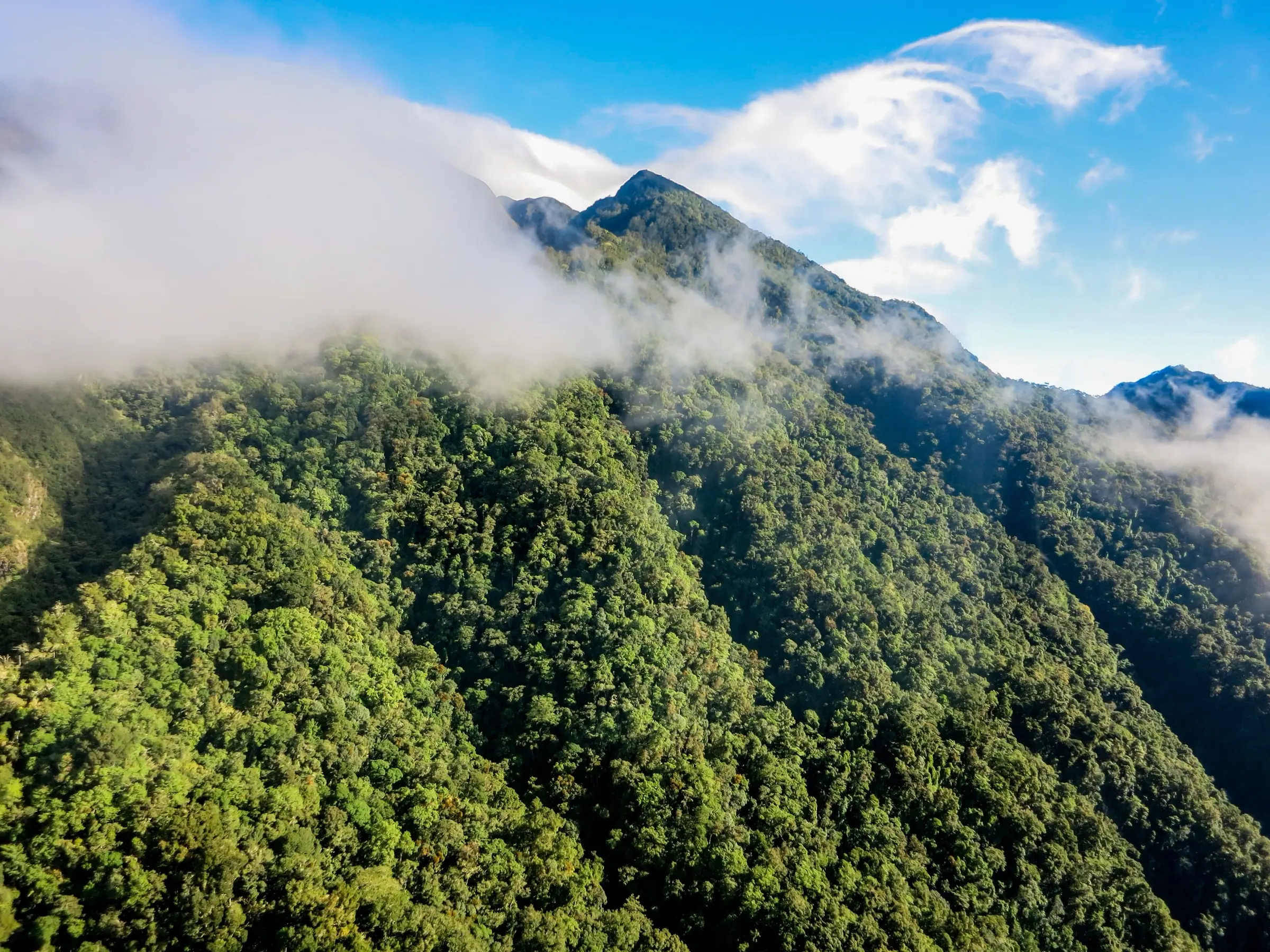
Put a kettle on in Boquete and it boils at about 96 C. Carry the same kettle to the summit of Volcán Barú, at about 3,474 m the highest point in Panama, and it boils at about 88 C (Wikipedia: High-altitude cooking, Wikipedia: Volcán Barú). That gap of about 8 degrees changes how a pour-over extracts.
The rule of thumb
Air pressure falls as you climb, and water boils at a lower temperature under lower pressure. The rough rule is 0.5 C less for every 150 m of elevation (Wikipedia). Real values move a little with the weather, but the rule is close enough for a kitchen.
Here is what that means on the road from the coast to the summit:
| Place | Elevation | Water boils at |
|---|---|---|
| Panama City, sea level | 0 m | 100.0 C (212 F) |
| El Valle de Antón | about 600 m | 98.0 C (208 F) |
| Boquete town | about 1,200 m | 96.1 C (205 F) |
| Volcán town | about 1,400 m | 95.4 C (204 F) |
| Elida Estate high lots | about 1,900 m | 93.8 C (201 F) |
| Volcán Barú summit | about 3,474 m | 88.3 C (191 F) |
Values are interpolated from the altitude table on Wikipedia’s High-altitude cooking page, which is derived from NASA data. Elevations come from Wikipedia’s pages on Boquete, Volcán and Volcán Barú, and from Elida’s tour pages for its high lots (Lamastus Family Estates). The Fahrenheit figures are our conversion.
The steps are small between neighbours and large over the whole climb. Elida’s high lots sit about 700 m above Boquete town, and water boils there about 2 degrees lower. From Boquete to the summit is a climb of about 2,270 m, and the boiling point drops by almost 8 degrees. Volcán town, on the other side of the mountain, is only about 200 m higher than Boquete, so its boiling point is less than 1 degree lower.
What the lower boil does to a pour-over
Hot water pulls flavour out of ground coffee, and cooler water pulls it out more slowly. At sea level a kettle straight off the boil gives you water near 100 C. In Boquete the same kettle tops out a few degrees lower before you have even poured. On the summit you start 12 degrees below sea level.
Brew the same recipe you use at home and the cup can taste thinner or sourer, because less has come out of the grounds in the same time.
How to adjust
Two changes make up some of the difference. This is general brewing guidance, not a measured recipe:
- Grind a little finer. Smaller particles give the water more surface to work on, which speeds extraction back up.
- Brew a little longer. Slow the pour so the water stays on the grounds longer, then taste the result.
Change one thing at a time. A scale with a timer makes it easier to repeat a cup you liked, and a gooseneck kettle makes a slower pour easier to control. Both are in the brewing gear section of the shop.
The farms are already up there
Most Boquete farm tours end with a tasting, so you will drink coffee brewed at altitude whether you plan to or not. Finca Dos Jefes sits at about 1,400 m on the slopes of Volcán Barú (Finca Dos Jefes). The Kotowa tour at Finca Río Cristal, run by Boquete Tree Trek, is at about 1,700 m (Boquete Tree Trek), where the rule of thumb puts boiling water at about 94 C. Elida’s La Torre tour drives up through lots above 1,900 m.
At the tasting, ask how they grind and how long they brew, and use that as your starting recipe when you brew the same coffee at your hotel.
Portable espresso up high
The Outin Mino, a battery espresso maker, heats 50 ml of water to 199.9 F, about 93.3 C, in about 149 seconds (Outin). That target sits below the boiling point in Boquete (about 96 C) and close to it on Elida’s high lots (about 94 C). On the summit of Volcán Barú, water boils near 88 C, below the Mino’s target. The Mino is listed in the shop with our Outin discount code.
On the summit
Volcán Barú last erupted about 1,550 years ago. The national park around it was declared in 1976 and covers about 14,325 ha. Boquete sits on its eastern flank and Volcán town on its western side, on an old lava flow at about 1,400 m. On a rare clear day you can see both the Pacific and the Caribbean from the top (Wikipedia).
If you carry a stove and a dripper up there for sunrise, grind finer than you would in Boquete and slow the pour.
Sources
- High-altitude cooking, Wikipedia
- Volcán Barú, Wikipedia
- Boquete, Chiriquí, Wikipedia
- Volcán, Chiriquí, Wikipedia
- Tour La Torre, Lamastus Family Estates
- Coffee tours, Finca Dos Jefes
- Tour de café Kotowa, Boquete Tree Trek
- Mino portable electric espresso machine, Outin
Written by CoffeePana from the sources above. Prices and times were checked in November 2026; farms change them, so confirm before you travel. If you spot an error, email a correction.